Application and Maintenance Guidelines for Needle Roller Bearings
Needle roller bearings have emerged as a preferred solution for compact mechanical designs due to their unique structural characteristics and superior mechanical properties. Their slim roller design and small radial dimension make them irreplaceable in narrow installation spaces where standard roller bearings and ball bearings cannot be deployed. In industrial production, these bearings are mainly divided into radial and thrust types, independently undertaking radial pressure and axial thrust respectively, meeting the complex force-bearing requirements of multi-dimensional mechanical movement.
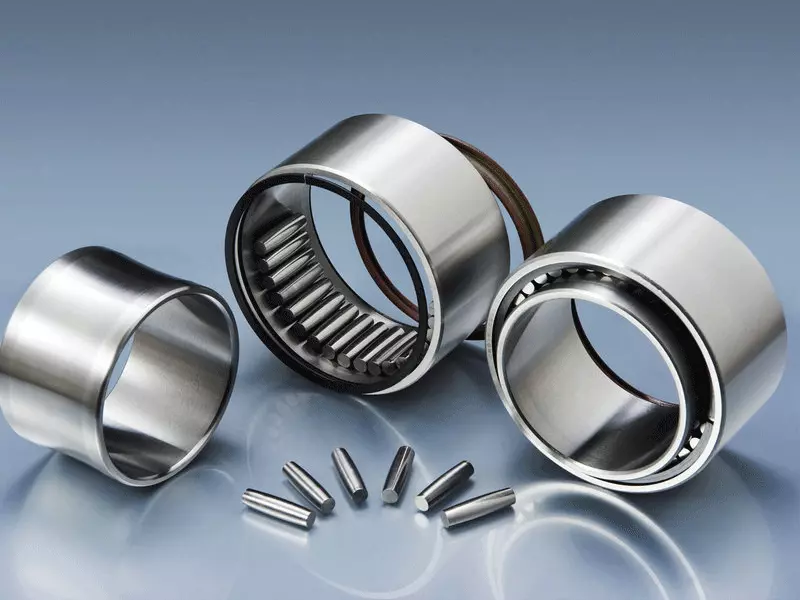
The automotive industry is the largest application scenario for needle roller bearings. They are widely installed in automobile gearboxes, crankshaft connecting rods, suspension systems and clutch components, enduring long-term high-speed rotation and variable load impacts. In addition, they are extensively used in aerospace precision instruments, textile machinery, printing equipment and engineering machinery. For oscillating mechanical structures such as robotic joints and precision sliding mechanisms, the low inertia feature of needle rollers effectively improves motion accuracy and response sensitivity, reducing mechanical lag and positioning errors.
Scientific maintenance is critical to extending the service life of needle roller bearings. During installation, workers must avoid violent knocking to prevent roller deformation and raceway damage, and ensure precise coordination between bearings and matching parts to eliminate clearance deviation. Regular lubrication maintenance is essential: sealed bearings can operate stably for a long time with pre-filled grease, while open-type bearings require periodic grease replacement to avoid dry friction. It is also necessary to regularly check for dust accumulation, corrosion and abnormal noise during operation. Timely replacement of aging and worn bearings can effectively prevent mechanical failure, ensure the stable operation of precision equipment, and reduce industrial production maintenance costs.
